

"The University of Arizona Campus Arboretum is a living laboratory promoting stewardship and conservation of urban trees through research, education, outreach and example."
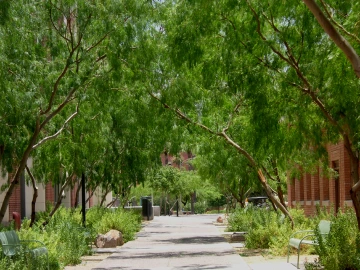
The University of Arizona campus is home to hundreds of tree and shrub species from arid climates on every continent on earth. Most of the roughly 400 acres of The University of Arizona's main campus are included in the boundaries of the Campus Arboretum. The trees within these boundaries, collected over the University's more than 125 year history, are an historical part of the University's land grant commitment to providing research and education to serve the needs of the state. The campus itself was used as a proving ground and living laboratory in sustainability, evaluating hundreds of new species and cultivars for their adaptation to this urban and arid region. In 2002, The University of Arizona Campus Arboretum was established to preserve, curate and enhance this extensive collection as a resource for research and educational programs that promote the historic, scientific, environmental, economic, aesthetic, and educational value of trees in urban deserts.
A BRIEF HISTORY
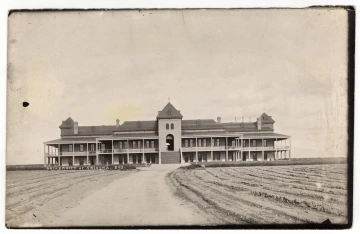
The University of Arizona main campus houses a truly unique collection of plants from arid and semi-arid climates around the world. These trees represent the University's historical dedication to sustainable desert horticulture and tell the story of the cultural evolution of the modern southwest. In the beginning, olive trees and date palms were trialed as potential cash crops and cacti were collected to encourage appreciation and learning about the native desert. By mid-century, growing urbanization and heightened awareness of natural resources, encouraged faculty like Dr. Warren Jones to shift the focus to improving landscape ornamentals. The University of Arizona campus is now the home of hundreds of native and arid-adapted trees and shrub species from every continent on earth. Many campus trees are the largest specimens in Arizona and have been designated as Great Trees of Arizona. Five of these Great Trees have been on the National Register of Big Trees. The Heritage Trees are stately reflections of the University's rich history. Several trees are unique to the Southwest; a few were the first of their kind to be planted in the Western Hemisphere.
In September, 2002, the UA Campus Arboretum was officially dedicated and accepted as a member of the American Public Garden Association with the charge to preserve and enhance this significant collection and to promote stewardship and conservation of urban trees. Ms. Elizabeth L. Davison, MS was appointed as the founding Director of the Program as a result of her significant efforts in championing the campus tree collection and organizing wide community advocacy in support of using the campus landscapes and historic trees as part of the academic missions. As a result of her efforts, the main campus, encompassing approximately 400 acres of landscaped spaces, create the boundaries of the Campus Arboretum and a foundation was established to use the campus trees for education, research and outreach. From this point on, the UA campus grounds were dedicated as a model of educational excellence with broad reach per the Campus Arboretum Concept Statement found here. Her early efforts yielded a full inventory of campus trees, the creation of a database to support curation by tracking tree and plant records, establishment of a steering committee and advisory board to ensure meaningful collaboration and partnership on and off campus, development of a Collections Policy, and Tree Care Plan to ensure trees were collected around clear goals, and to support science-based horticultural care of the collection. Additionally, efforts to transform the campus grounds into spaces with educational value (interpretive gardens) were initiated beginning in 2005, with the formal dedication of the Taylor Family Botanical Plaza in front of the newly refurbished Herring Hall. In 2010, the University of Arizona Campus Arboretum was recognized nationally with a Tree Campus USA designation by the National Arbor Day Foundation Foundation.
In 2010, upon the retirement of Founding Director Davison, Dr. Tanya Quist was hired to direct the program. Between 2010 and 2026, she built on Director Davison’s significant accomplishments to protect and expand the collection, improve record keeping and curation, further develop educational training programs for students, deepen partnership with UA operational units, and create myriad engagement opportunities to promote use of campus for research, education and training.
Specifically, Director Quist oversaw the renovation of the website, collections database, developed an application to coordinate asset management with operational units. Her partnership with the Desert Legume Program, other arboreta, nurseries, plant collectors, and effective partnership with the UA's Planning Design and Construction group (especially partnership with Mr. Mark Novak, University Landscape Architect) was fruitful in expanding collections diversity from 478 taxa in 2010 to 816 taxa in 2026.
Director Quist also improved educational value and engagement with the living collection by replacing all existing botanical signage so they included QR codes that afforded deeper learning about each tree species. She then worked with students to revise more than 1100 taxa pages so that the QR coded signs connected to detailed research relating to botanical characteristics, natural history, cultivation ethnobotanical uses of each plant and detailed photos of a representative accession of each taxa in the collection. The revision of the website in 2012 and again in 2025 deepened opportunities to extend university science to the public by providing curated resources relating to tree selection and care. Between 2020 and 2026, the website attracted nearly 200,000 views per year from Arizona and to desert-locations around the world.
Director Quist also raised funds to renovate and provide interpretation of historic landscapes such as the Presidents' Pond (AKA Turtle Pond), the Howard Gentry Agave Garden, and The Joseph Wood Krutch Garden, and to build other interpretive gardens including the Fragrance Garden, the Resilience Garden, the Wellness Walk and the Coral Reef Garden. Despite the cost of these endeavors, thanks to generous donations and fiscal discipline the Campus Arboretum’s endowments grew seven-fold between 2010-2025.
To engage the public further, Dr. Quist developed a tour program - by creating public guided tours initiated by student interns who drafted a series of guided tours, then by recruiting and training Pima County Master Gardener volunteers to improve these tours, expand marketing, and train as guides. In 2024-2026, these tours and associated events engagement reached 3000 people per year. However, to expand reach beyond the capacity of the guided tours, Dr. Quist supervised student interns to mirror those tours as mobile and self-guided experiences.
Dr. Quist’s primary role as Professor of Practice (teaching) also afforded the development of a robust training program for hundreds of undergraduate students. These students engaged in academic projects using the living collections, developing campus interpretative spaces and providing service learning benefits for partners on and off campus. These formative experiences built and reinforced classroom learning, promoted leadership skill and strengthened student professional networks. Many students have gone on into careers in public and landscape horticulture, conservation, law, academia, and business – exemplifying the broad relevance of the arboretum as a tool in academic excellence.
To learn more about the scope and impacts of the program, visit the "Mission Driven Projects" tab.
The Making of the Campus Arboretum - An Oral History
President Homer Shantz's Photo Collection
Learn more about Homer Shantz photos in the UA Special Collections Library.